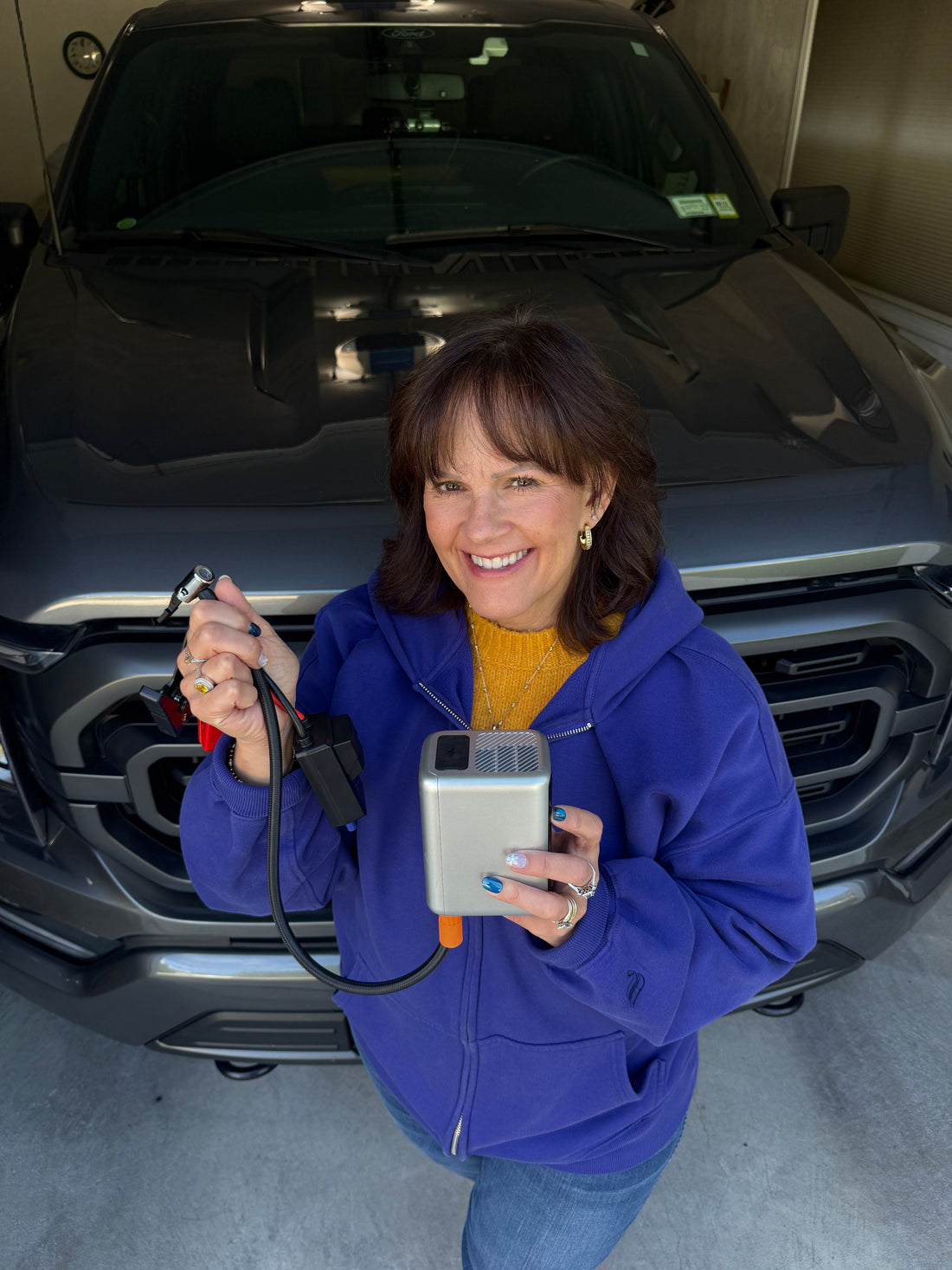



One small device. It fills your tires, starts your car — and anyone can use it.
The size of a large phone, finished in brushed metal — and built, above everything, to be easy. It stops itself at the right pressure, and the clamps only work when connected right. You cannot do it wrong. Watch:
Everything it does, in 35 seconds.
Why two? The second one almost always goes in the car of the person who'd otherwise be calling you from a parking lot — a daughter's first car, a partner's commuter, your mom's. One driveway rescue and it has paid for itself. It's also the rare kind of gift that actually gets used — for a parent who drives alone, or a daughter with her first car.
Free shipping · order today, arrives Mon Oct 26 – Thu Oct 29
The best day to own this is the day before you need it. A slow leak only gets worse — and batteries pick the coldest morning of the year to quit.
Secure checkout — encrypted end to end, processed by Shopify Payments and PayPal.
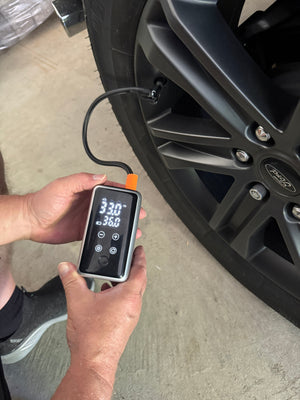
See it working — the tire, then the van
Nothing sped up, nothing cut. The hose goes on the valve, the pump runs and stops itself at the number. Then the clamps go on a van battery: red, black, green light, start.
Watch how little the person does. Screw on, press, wait. That's the whole skill.
How to use it — it's genuinely this easy
This is the entire manual, honestly.
Low tire
- Screw the hose onto the tire valve — same fitting as the gas station pump.
- Press the car button. It sets itself to what a car tire needs (your exact number is on the sticker inside your driver's door).
- Press start. It fills, then stops itself at the number — you can't over-inflate.
About 90 seconds on a low tire, and it stops itself.
Won't start
- Clip red to red, black to black on the battery.
- Wait for the steady green light — the smart cable checks everything for you first. If anything is wrong, it does nothing and tells you.
- Turn the key. The car starts. Unclip and drive.
The clamps cannot spark — ever. People who have never used jumper cables do this on the first try.
Small enough that you'll actually have it
Most devices that do this are the size of a lunchbox. The big ones end up in the trunk under the shopping bags — and when the day finally comes, they're flat.
This one fits in one hand. It lives in your door pocket, where you see it every time you get in the car. So it's still charged when you need it.


The mornings this was built for
Tuesday, 7:40am. The tire light has been on since Friday. School run in twenty minutes. Ninety seconds standing in your own driveway while it fills the tire and stops itself — light off, kids in the car, gone.
The grocery store lot, 6pm. You turn the key and nothing happens. Instead of an hour on hold with roadside assistance: red clip, black clip, green light — and you drive home. Nobody had to come rescue you. You had the thing.

Why this one finishes the job
The #1 complaint about every device in this category: it overheats and quits after a minute or two, before the job is done.
The JumpAir Pro has a real cooling fan inside — the reason it can run up to 20 minutes straight and finish all four tires in one go.
And it watches its own temperature the whole time, from freezing cold to summer heat (-10°C to +45°C). If anything is off, it protects itself instead of breaking.
What you'll actually experience
It's loud. Like a small hair dryer, for about ninety seconds. Anything that moves air this fast is.
Give it a top-up charge every 2–3 months. Like a phone you rarely use. Door pocket, not trunk, is what makes this easy to remember.
A completely flat tire takes longer. About 6–7 minutes instead of ninety seconds.
Below freezing, fewer starts per charge. That's lithium batteries, not a defect. Go into winter charged.
It wants at least half a charge to start a car, and it isn't waterproof. Keep it charged, keep it dry — that's the whole care routine.

Compared to what you'd do otherwise
| JumpAir Pro | Roadside assistance | Gas station pump | Garage appointment | |
|---|---|---|---|---|
| Where it happens | Your driveway | Wherever you're stuck | Wherever the station is | Their workshop |
| How long | About 2 minutes | 45 min to 2 hours | 20 min round trip, if it works | Half a day |
| What it costs | Once | “Free” — until the tow miles and the ruined tire | Quarters, when working | $30–80 plus your morning |
| Works at 6am | Yes | Eventually | If it's open | No |
We don't complicate things
Why should putting air in a tire need a garage appointment? Why should a dead battery mean an emergency call and an hour on the shoulder? It never needed to be complicated — so we made it simple. One small device. One button. Done in your driveway.
The only thing we ask is prevention. Don't wait until you're there. This belongs in every car — like the spare key you hope you'll never need.

What the numbers on the screen mean
In plain words — because nobody should need an engineering degree to put air in a tire.
The exact numbers, if you like details
Battery: 10,000 mAh (29.6 Wh) · Starting power: 800 A peak (400 A start current) for 12 V car batteries · Pump: 90 W, runs up to 20 minutes continuously · Recharges by USB-C fast charging (18 W) · Presets: car 36 PSI, motorcycle 32, bicycle 30, ball 8, custom · Units: PSI, BAR, KPA, kg/cm² · Smart clamp with reverse-polarity and short-circuit protection · Light: white, SOS, and fast-flash · Works from -10°C to +45°C · Fills a completely flat car tire in about 6.5 minutes · Spark-proof clamps · CE and FCC certified · If stored unused, charge every 3 months.

What's in the box
The JumpAir Pro · the smart jumper clamps · the air hose · 4 nozzle tips (bike tires, balls, inflatables) · USB-C charging cable · a one-page guide you won't actually need. Nothing to assemble.
Why this week, and not “sometime”: a slow leak doesn't hold steady — it widens. A fading battery doesn't recover — it keeps fading. Nothing about waiting makes either cheaper or easier; waiting only moves the breakdown closer to a morning that matters. Two minutes in your driveway this week is the whole alternative.
Questions, answered honestly
I've never used anything like this. Is it complicated?
No. For the tire: screw it on, press the car button, press start — it stops itself. For the battery: red clip, black clip, wait for the green light, turn the key. There are no settings to understand and nothing you can break by pressing the wrong thing.
How big is it, really?
It fits in one hand — about 11 cm tall, smaller than a water bottle. It sits comfortably in a door pocket or glovebox.
Is something this small actually powerful enough?
For a low tire and a dead car battery, yes — comfortably. What small devices usually get wrong is heat: they run for a minute and shut off. This one has a cooling fan, which is what lets it finish the job.
Aren't these 2-in-1 devices worse than two separate tools?
Honest answer: if you run a workshop and use both functions every week, buy two dedicated tools. For everyone else the math is different — the tool that saves you is the one that's actually in the car, charged. One small device you keep beats two big ones you left in the garage. And if either function ever fails, we replace the whole unit — that's the 12-month warranty.
Is it safe if I've never touched a car battery?
That's exactly who the clamps were designed for. They cannot spark, they detect reversed connections and short circuits, and they simply do nothing until everything is right — then the green light tells you.
Is it loud?
Yes. Like a small hair dryer, for about ninety seconds on a low tire. Anything that moves air this fast is.
Will it be dead when I actually need it?
It holds its charge for months, but give it a top-up every 2–3 months, like a phone you rarely use. Keeping it in the door pocket rather than the trunk is what makes people remember. The ones that fail are the ones people never see.
Will it work if my tire is completely flat?
Yes — about 6–7 minutes rather than ninety seconds. Important: if the tire went flat suddenly, or you can hear air escaping, or you can see damage, don't drive on it. Air won't fix a hole. Call for help.
Does it work in cold weather?
Yes, from -10°C — and it watches its own temperature. Below freezing you'll get fewer jump starts per charge; that's lithium batteries, not a fault. Go into winter with it charged.
What if my battery is completely dead, not just weak?
It handles a normal dead battery — lights left on, a car that sat for weeks. And for a battery so drained the device can't even detect it, there's a rescue mode: a 2-second long-press forces the start. If a battery has genuinely failed, no jump starter fixes that — you need a new battery.
Can it charge my phone?
Yes — there's a USB port on the side. It holds several full phone charges.
Can I use it on my other car? My daughter's car?
Yes. It's not tied to a vehicle. Plenty of people buy the two-pack to leave one in a family member's car — it also makes a genuinely useful gift for a parent or a new driver.
What if it breaks?
Email us with your order number and we replace it — that's the 12-month replacement warranty. And 60-day returns if you change your mind — we pay the return shipping. A person answers; support isn't outsourced.
How fast does it ship, and will I pay anything at delivery?
2–5 business days from our warehouse in Pennsylvania. The price on this page is the price you pay — no shipping cost, no taxes added at checkout, nothing owed to the courier at your door.
If it ever lets you down, we replace it.
Email support@jumpairpro.com with your order number. A person reads it and answers — usually the same day. 12-month replacement warranty, 60-day free returns.
JumpAir · 102 Queens Dr, King of Prussia, PA 19406, USA
 $69.00Buy now